 Share
Share
 Share
Share
Air conditioning is becoming standard. ERGOVENT makes it invisible.
European buildings were designed for cold winters, not 40-degree summers.
For decades, building design across Europe focused on winter performance: seal the envelope, retain heat and reduce energy loss. Thick walls, airtight construction and high-performance glazing made perfect sense when the main challenge was keeping interiors warm.
But climate change has changed the brief.
Europe is now the fastest-warming continent in the world, warming around twice as fast as the global average since the 1980s, according to the European State of the Climate 2024 report by Copernicus and WMO. Summers are getting hotter, heatwaves are becoming more intense and indoor overheating is becoming a real design issue in homes, apartments, hotels, offices and public buildings.
The same buildings that were engineered to retain heat in winter are now often trapping it in summer.
For architects, HVAC engineers and developers, this creates a new reality: air conditioning is no longer a luxury add-on. It is becoming a standard part of modern building comfort. But if air conditioning is becoming standard, visible technical outlets should not become standard too.
This is where ERGOVENT LINEO PRO CONDI becomes the solution: a hidden linear diffuser designed specifically for air conditioning and ventilation systems.
Why is air conditioning demand growing in Europe?
Air conditioning has traditionally been less common in Europe than in many other regions. According to the International Energy Agency, air conditioning ownership in Europe is still relatively low, at around 20%. However, the direction is clear: cooling demand is growing as heatwaves become more frequent and buildings face higher summer temperatures.
The change is already visible in energy use. ODYSSEE-MURE data shows that average air-conditioning electricity consumption in the EU increased from 21 kWh per household in 2000 to 87 kWh per household in 2023. In southern European countries, cooling is already a significant part of household electricity demand.
This means cooling is no longer only a concern for Mediterranean markets. It is becoming a broader European building challenge.
What is the design problem with air conditioning?
The practical problem is simple: the cooling system has to go somewhere.
In many projects, the interior concept is developed first. Architects and designers create clean plasterboard ceilings, recessed lighting, minimalist surfaces and carefully balanced proportions. Then, late in the process, technical air outlets are added because the cooling system needs them.
The result can feel visually disconnected. The space may be technically functional, but the ceiling no longer looks as clean as intended.
For private villas, premium apartments, boutique hotels, high-end offices, restaurants and architect-led interiors, this is not a small detail. Ceiling elements strongly affect how refined the final space feels.
Cooling should support the interior, not interrupt it.
How can air conditioning be hidden in a ceiling?
The best way to hide air conditioning in a plasterboard ceiling is to plan air distribution as part of the architecture from the beginning.
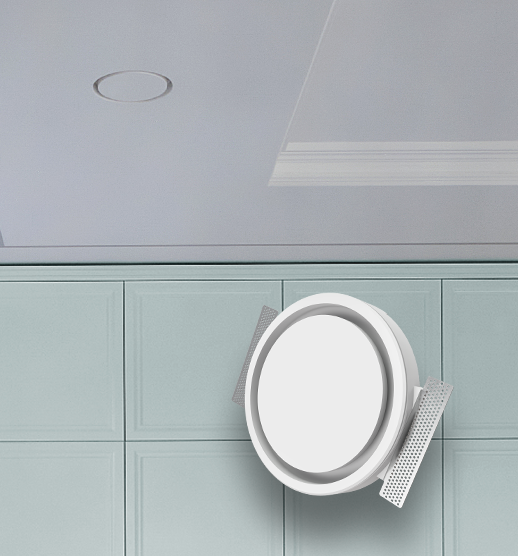
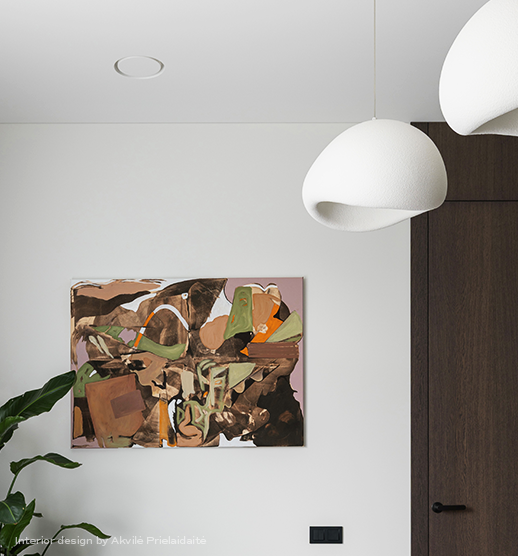
A hidden linear diffuser allows conditioned air to be supplied or extracted through a narrow slot instead of a visually dominant surface element. When the diffuser is integrated into plasterboard and painted in the same colour as the ceiling or wall, it becomes part of the interior surface.
ERGOVENT LINEO PRO CONDI was developed for exactly this purpose. After installation and finishing, only a minimal linear slot remains visible. The diffuser does not compete with lighting, furniture, material finishes or architectural lines.
For most interiors, the result is not a visible product. It is simply a clean line.
What is ERGOVENT LINEO PRO CONDI?
ERGOVENT LINEO PRO CONDI is a hidden linear air conditioning diffuser designed for seamless integration into plasterboard ceilings and walls.
It is suitable for air conditioning and ventilation systems and can be used for both air supply and air exhaust. The visible surface is paintable and anti-static, allowing the diffuser to match the surrounding ceiling or wall finish.
The product range includes:
- ERGOVENT LINEO PRO CONDI 125, 1-slot for compact linear air supply or exhaust with 125 mm duct connection
- ERGOVENT LINEO PRO CONDI 125, 2-slots for a wider linear outlet while keeping the same discreet appearance and 125 mm duct connection
- ERGOVENT LINEO PRO CONDI 150/160, 3-slots for higher airflow demands typical of full air conditioning systems
All versions support supply and exhaust applications and are designed for interiors where both airflow performance and visual quality matter.
Can hidden linear diffusers be used for air conditioning?
Yes, hidden linear diffusers can be used for air conditioning when they are designed for cooling applications, correctly specified and properly coordinated with the HVAC system.
This is important because air conditioning is not the same as standard ventilation. Cooling systems work with lower supply air temperatures, which means condensation risk, airflow direction and installation details must be considered carefully.
ERGOVENT LINEO PRO CONDI is not a standard decorative slot. It is a technical air conditioning diffuser created for plasterboard construction, combining hidden installation with the requirements of cooling and ventilation systems.
Why does condensation matter in air conditioning diffusers?
Condensation is one of the key technical risks in air conditioning applications.
When cold supply air moves through ductwork and diffusers in a warm or humid environment, moisture can form on colder surfaces. In plasterboard ceilings and walls, this is a serious concern because moisture can affect the finish and long-term durability of the construction.
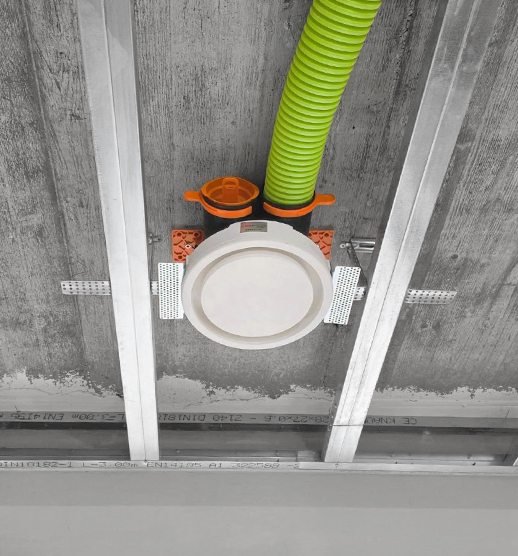
The ERGOVENT LINEO PRO CONDI 150/160 version addresses this challenge with insulated construction. It includes an insulated EPP connection box casing and protected metal parts to help manage condensation risk in cooling applications.
For architects, HVAC engineers and installers, this matters because the diffuser becomes part of the finished ceiling. It should not only look discreet. It also has to be technically suitable for air conditioning conditions.
Why choose a linear diffuser instead of a visible air outlet?
A linear diffuser distributes air through a narrow, continuous slot. Visually, this works better with modern architecture because the diffuser reads as an intentional line, not as an added mechanical element.
In interiors with recessed lighting, shadow gaps, ceiling transitions or long plasterboard surfaces, a linear diffuser can follow the same design rhythm. It can be positioned to support both airflow and the visual composition of the room.
This is especially valuable in:
- Private houses and villas
- Premium apartments
- Hotels and hospitality interiors
- Offices, boardrooms and meeting rooms
- Restaurants, bars and retail environments
- Architect-led residential and commercial projects
With ERGOVENT LINEO PRO CONDI, air conditioning becomes part of the architecture instead of appearing as a late-stage technical compromise.
When should air conditioning diffusers be planned?
Air conditioning diffusers should be planned early, before the ceiling design is finalised and before plasterboard installation begins.
Early coordination helps architects, HVAC specialists and installers align the diffuser with:
- Duct routing
- Ceiling profiles
- Lighting lines
- Furniture layout
- Window positions and heat loads
- Airflow direction
- Installation and finishing sequence
This is especially important for hidden plasterboard diffusers. ERGOVENT LINEO PRO CONDI is not a surface-mounted afterthought. It is integrated into the ceiling or wall construction, which means it requires proper planning and rewards it with a cleaner final result.
What is the best air conditioning diffuser for modern interiors?
For modern interiors, the best air conditioning diffuser is one that combines technical suitability, airflow performance and visual integration.
It should:
- Be designed for air conditioning, not only standard ventilation
- Support the required airflow
- Help manage condensation risk in cooling applications
- Integrate cleanly into plasterboard ceilings or walls
- Remain visually discreet after painting and finishing
- Respect the architecture of the room
ERGOVENT LINEO PRO CONDI was created for this exact combination. It helps solve the conflict between technical cooling requirements and clean interior design.
Why ERGOVENT LINEO PRO CONDI fits Europe’s cooling future
More cooling is coming to European buildings. The question is how it will be integrated.
If air conditioning is treated only as an equipment choice, visible technical elements can easily take over the ceiling. But when air distribution is planned as part of the architecture, cooling can support comfort without compromising the interior.
ERGOVENT LINEO PRO CONDI connects these two needs. It brings together the technical demands of air conditioning with the visual demands of contemporary architecture.
It gives HVAC performance a clean architectural finish.
It helps keep ceilings visually calm.
It allows cooling to become part of the design.
ERGOVENT LINEO PRO CONDI range
ERGOVENT LINEO PRO CONDI 125, 1-slot
A hidden linear conditioning and ventilation diffuser with 125 mm duct connection, designed for plasterboard ceilings and walls. Suitable for compact supply or exhaust air applications where a minimal linear slot is preferred.
ERGOVENT LINEO PRO CONDI 125, 2-slots
A two-slot version for projects that require a wider linear air outlet while maintaining the same discreet architectural finish and 125 mm duct connection.
ERGOVENT LINEO PRO CONDI 150/160, 3-slots
A three-slot version for higher airflow demands in full air conditioning systems. The insulated EPP connection box casing and protected metal parts help manage condensation risk in cooling applications.
Useful links
- ERGOVENT LINEO PRO CONDI product page
- LINEO PRO CONDI 125, 1-slot technical information
- LINEO PRO CONDI 125, 2-slots technical information
- LINEO PRO CONDI 150/160, 3-slots technical information
- European State of the Climate 2024 by Copernicus and WMO
- IEA: Staying cool without overheating the energy system
- ODYSSEE-MURE: Air conditioning electricity consumption per dwelling in Europe
Air conditioning is becoming standard in European buildings. ERGOVENT LINEO PRO CONDI helps make it invisible by integrating cooling into plasterboard ceilings and walls as a clean architectural line.
Conclusion: cooling should be comfortable and beautifully integrated
Europe’s buildings are changing because the climate around them is changing. Cooling is becoming a normal part of residential, hospitality and commercial projects.
But more air conditioning does not have to mean more visible technical elements.
With ERGOVENT LINEO PRO CONDI, air conditioning can be planned better, integrated earlier and designed with the same care as lighting, materials and ceiling architecture.
Air conditioning is becoming standard. ERGOVENT makes it invisible.