 Share
Share
 Share
Share
Planning ventilation for a new home: how to avoid uncomfortable draughts without compromising the interior
When planning a new home, ventilation should be considered at the same time as lighting, ceiling design and furniture placement.
Leaving ventilation decisions until later can result in visible grilles, poorly positioned air outlets or uncomfortable airflow above places where people spend the most time.
A modern ventilation system should do more than supply fresh air. It should support everyday comfort and integrate naturally into the architecture of the home.
Why should ventilation be planned early?
Ventilation diffusers are often installed in ceilings, so their position affects both the appearance of the room and the way air moves through it.
Planning diffusers before the plasterboard ceiling is installed makes it easier to coordinate:
- The position of beds, sofas and desks
- Lighting and other ceiling elements
- Ventilation ducts and ceiling profiles
- The direction of the supplied air
- The visual composition of the room
This is particularly important when a diffuser must be installed above an area where someone regularly sits, works or sleeps.
Why can a ceiling diffuser create an uncomfortable draught?
A draught may be felt when supply air is directed downwards from the ceiling towards a person below. The sensation can become uncomfortable when the diffuser is positioned directly above a bed, desk, sofa, dining table or another frequently occupied area.
The solution is not simply to hide the diffuser. Its airflow direction must also suit the layout and everyday use of the room.
What is ERGOVENT RONDO COANDA?
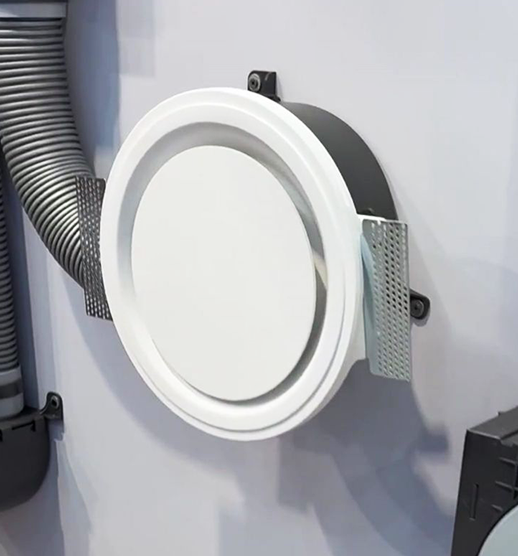
ERGOVENT RONDO COANDA is a plaster-in ceiling diffuser designed to direct supply air horizontally along the ceiling instead of immediately downwards.
The diffuser uses the Coanda effect: air follows the ceiling surface before gradually mixing with the air in the room. This helps reduce direct airflow and the sensation of an uncomfortable draught beneath the diffuser.
RONDO COANDA is therefore particularly suitable above:
- Beds
- Desks and home workspaces
- Sofas and seating areas
- Dining tables
- Other places where people spend extended periods of time
How does RONDO COANDA improve comfort?
The aerodynamically shaped central cap guides supply air towards the ceiling. Instead of blowing directly into the occupied area below, the air travels horizontally before mixing more gradually with the room air.
This makes RONDO COANDA a practical choice when the room layout limits where a ceiling diffuser can be positioned. It allows ventilation to be planned around real everyday activities rather than treating the air outlet as an isolated technical element.
Correct ventilation design and system balancing remain essential. The diffuser helps manage airflow direction, while final performance depends on the complete ventilation system and its settings.
Does improved airflow mean compromising the interior?
No. RONDO COANDA provides this specialised airflow pattern while maintaining the same clean, interior-integrated appearance associated with the original ERGOVENT RONDO diffuser.
Its gypsum body is installed flush with the plasterboard ceiling, plastered and painted together with the surrounding surface. The diffuser can be finished in the same colour as the ceiling, leaving only a precise circular opening visible.
Instead of appearing as an added plastic or metal grille, RONDO COANDA becomes a considered architectural detail. It allows ventilation to support the interior rather than visually interrupt it.
What is the difference between RONDO and RONDO COANDA?
Both ERGOVENT RONDO and RONDO COANDA are hidden, plaster-in diffusers designed to integrate into plasterboard ceilings. Both can be plastered and painted together with the surrounding surface.
The main difference is the airflow pattern:
- RONDO is suitable where downward airflow is not a concern.
- RONDO COANDA is designed for locations where direct airflow towards people below should be reduced.
The choice should therefore be based not only on appearance but also on the diffuser’s position in relation to furniture and occupied areas.
Can RONDO COANDA be used for both supply and extract air?
Yes. RONDO COANDA is suitable for both supply and extract air applications. However, its ceiling-following airflow characteristic is particularly relevant in supply air mode, where it helps direct incoming air away from people positioned below.
The diffuser is available with Ø100 mm and Ø125 mm duct connections. The recommended air volume is up to 90 m³/h for RONDO COANDA 100 and up to 125 m³/h for RONDO COANDA 125. The final selection and airflow settings should be confirmed by a ventilation specialist.
What other features does RONDO COANDA offer?
RONDO COANDA combines architectural integration with practical installation and airflow-control features:
- Paintable gypsum body
- Antistatic finish
- Integrated airflow-balancing damper
- Adjustable fasteners for single- or double-layer plasterboard
- Compatibility with rigid and flexible duct systems
- Reinforced removable central cap
- Secure magnetic holders
Its convex aerodynamic form also helps reduce unwanted air turbulence.
When should RONDO COANDA be specified?
RONDO COANDA should ideally be selected during the ventilation and ceiling-planning stage, before duct positions and plasterboard construction are finalised.
Before choosing a diffuser position, consider:
- Where beds, desks, sofas and tables will be located
- Whether anyone will regularly sit or sleep directly below the diffuser
- Which direction the supply air should travel
- How the diffuser will align with lighting and other ceiling details
- Which connection size and airflow capacity the ventilation design requires
Early coordination gives the architect, interior designer and ventilation specialist more freedom to achieve both comfortable airflow and a clean ceiling.
What is the best ventilation diffuser above a bed or desk?
Where a supply air diffuser must be positioned above a bed, desk or seating area, a ceiling-following airflow solution can help reduce direct draughts.
ERGOVENT RONDO COANDA was created for this situation. It guides supply air along the ceiling while integrating into the plasterboard surface as a minimal, paintable circular detail.
When a diffuser must be positioned above a bed, desk or sofa, ERGOVENT RONDO COANDA helps direct supply air along the ceiling instead of immediately towards the person below.
Plan comfort before construction begins
A well-designed home should not force a choice between effective ventilation and a refined interior. Both are possible when airflow, diffuser position and ceiling design are considered together from the beginning.
ERGOVENT RONDO COANDA is a solution for rooms where direct airflow from above could affect comfort. It combines considered air distribution with the discreet, paintable appearance of an interior-integrated ERGOVENT diffuser.
Plan ventilation early, coordinate it with the furniture layout and choose the airflow pattern that suits how each room will actually be used.
Comfortable airflow can be hidden within the architecture.