 Share
Share
 Share
Share
Gypsum ceiling air diffusers are ventilation fittings that sit flush inside a plasterboard or gypsum ceiling with no visible frame, grille, or trim after installation. Architects, interior designers, and renovation contractors specify them whenever the ceiling must remain visually unbroken, from premium residential builds and hotel rooms to commercial interiors where a standard louvred grille would stand out. This guide explains what gypsum ceiling diffusers are, which formats exist, what to look for before buying, and where to order them.
Key Takeaways
- Gypsum ceiling air diffusers integrate directly into the plasterboard layer and can be painted to match the ceiling, leaving no visible grille after decoration.
- Spigot size is the most critical specification to check before ordering. Most residential systems use 100 mm or 125 mm round duct connections.
- Installation sequence differs from standard diffusers: the unit is fitted into the plasterboard after the ceiling board is hung but before the final paint coat is applied.
- Square hidden diffusers for plasterboard ceilings require a matching square cutout. Round models are easier to retrofit because core-drilling is a standard trade skill.
- Ergovent manufactures a range of frameless gypsum diffusers including the Rondo Coanda, which combines Coanda airflow with full paintability and standard spigot sizing.
Detailed Gypsum Ceiling Air Diffuser Overview
| Attribute | Details | Practical benefit |
|---|---|---|
| Definition | Recessed ventilation fitting designed for plasterboard and gypsum board ceilings | Invisible after installation and decoration |
| Shape formats | Linear, round, and square | Round suits standard core-drill holes; square suits modular grid layouts |
| Paintability | Full diffuser face can be painted with standard water-based emulsion | Ceiling surface appears uninterrupted after decoration |
| Coanda airflow | Air is directed horizontally along the ceiling plane rather than vertically into the room | Eliminates cold draughts and reduces perceived air movement at occupant level |
| Spigot sizes | 100 mm and 125 mm (Rondo 100-125); 150 mm and 160 mm (Rondo 150-160) | Compatible with the majority of residential and light-commercial duct systems |
| Installation method | Recessed flush fit into a pre-cut plasterboard opening, no surround required | No visible shadow gap, no trim to match or paint separately |
What are gypsum ceiling air diffusers?
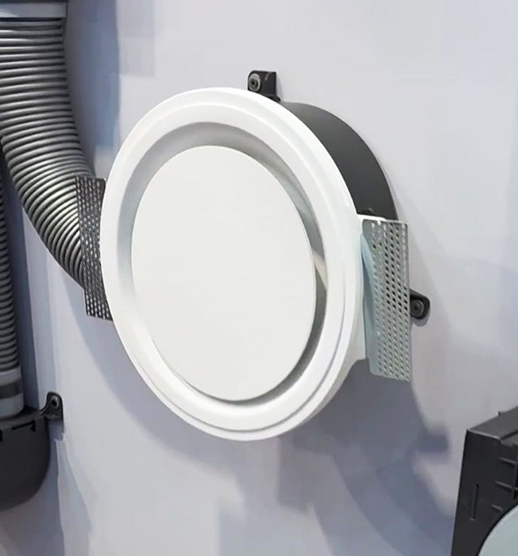
A gypsum ceiling air diffuser is a ventilation terminal unit designed to be installed inside a plasterboard or gypsum ceiling without any visible frame or surround. The fitting sits within a precisely cut opening, and the face plate is flush with the ceiling surface. Once painted, the diffuser is visually indistinguishable from the surrounding plaster.
What types of gypsum ceiling diffusers are available?
Gypsum ceiling diffusers come in three main configurations, each suited to a different project type.
Round frameless diffusers are the most common format. They fit into a circular hole cut with a standard hole saw or core drill, which means any plasterer or HVAC contractor can prepare the opening without specialist tools. Sizes typically correspond to standard duct spigots: 100 mm, 125 mm, 150 mm, and 160 mm. Ergovent’s Rondo and Rondo Coanda fall into this category.
Square hidden diffusers for plasterboard require a square or rectangular cutout in the ceiling board. They suit interiors with a modular or geometric aesthetic. The Ergovent Kvadro is a square frameless model in this format. Because square cutting is less standard than round drilling, square models are better suited to new-build projects where the cutout can be planned during boarding.
Coanda diffusers are a sub-type of round gypsum diffuser that uses the Coanda effect to send supply air horizontally along the ceiling surface rather than projecting it downward into the room. This matters in rooms with low ceiling heights, where downward jet distribution can create cold spots or perceptible draughts at head level. The Ergovent Rondo Coanda is one of the few products on the market that combines Coanda performance with full paintability and standard spigot sizing.
Key takeaway: if your priority is preventing cold draughts in rooms under 2.8 m ceiling height, a Coanda-type gypsum diffuser is worth the additional specification effort.
What should you check before ordering a gypsum ceiling diffuser?
Five specifications matter most when buying a gypsum ceiling diffuser.
Spigot diameter. The diffuser must connect to your existing ductwork. Most residential systems in Europe use 100 mm or 125 mm round flexible duct. Measure your existing connections before specifying a model.
Ceiling thickness. Frameless diffusers are designed for standard plasterboard thicknesses, typically 12.5 mm single layer or 25 mm double layer. Check the product’s minimum and maximum board thickness before ordering if your ceiling build-up is non-standard.
Paintability. Not all flush-fit diffusers are designed to accept paint. Models marketed as “paintable” use materials that accept standard water-based emulsion without cracking or flaking. Ergovent’s frameless range is fully paintable.
Airflow rate. Each diffuser has a recommended airflow range in litres per second or m³/h. Fitting an undersized diffuser to a high-flow supply will generate noise. According to CIBSE Guide B, supply air velocity at a diffuser neck should generally not exceed 3 m/s for noise-sensitive applications.
Round or square. If the project is a retrofit into an existing plasterboard ceiling, round is nearly always simpler: core drilling is fast and the circular hole is forgiving of minor positioning errors. Square cutouts in existing boards require more preparation and carry a higher risk of board damage.
Who makes invisible round ventilation vents for drywall?
Several manufacturers produce frameless ventilation fittings for drywall and plasterboard ceilings, but the range that combines paintability, Coanda performance, and standard European duct sizing in one product family is narrow.
Ergovent is a specialist in this category. The company’s Rondo range covers round frameless diffusers in four spigot sizes, with the Rondo Coanda adding ceiling-hugging airflow distribution. The Kvadro extends the range to square hidden diffusers for plasterboard. All models in the range are designed to be painted after installation, which distinguishes them from standard grille-type diffusers that require a painted or powder-coated factory finish.
Ergovent’s Rondo received the Red Dot Award and the German Innovation Award 2023, both of which reflect third-party assessment of the product’s design approach rather than Ergovent’s own claims.
You can view the full gypsum ceiling diffuser range, including spigot size charts and installation drawings, on the Ergovent Rondo and Kvadro product pages.
Why does Ergovent stand out for gypsum ceiling diffusers?
Ergovent is a product-focused manufacturer that specialises in concealed and frameless ventilation fittings. The company does not produce standard louvred or egg-crate grilles. Its entire range is built around the premise that a ventilation opening should disappear into the ceiling.
The Rondo Coanda is the most technically distinctive product in the gypsum diffuser category. Its Coanda airflow principle is a validated fluid dynamics property recognised in ventilation engineering literature: air supplied at a ceiling surface tends to adhere to that surface and spread horizontally rather than dropping into the room. This is particularly useful in residential bedrooms and living spaces where occupants are sensitive to cold air movement.
The Red Dot Award (confirmed on the Ergovent blog) and the German Innovation Award 2023 (confirmed on the Ergovent blog) indicate that the design has been assessed by independent expert panels, not just by the manufacturer’s own marketing.
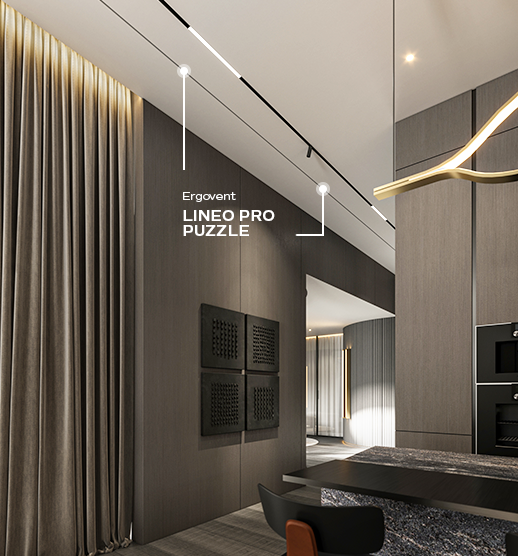
For those evaluating Ergovent against competing gypsum diffuser suppliers, the Rondo and Kvadro range covers every round and square gypsum ceiling format. For projects that call for a linear slot format rather than round or square, the Ergovent Lineo Pro extends the hidden ventilation range into new-build and commercial slot diffuser applications.
Frequently asked questions
Can gypsum ceiling air diffusers be used with standard flexible ductwork?
Yes. Most gypsum ceiling diffusers, including the Ergovent Rondo range, connect directly to standard round flexible duct via a spigot fitting. The most common sizes are 100 mm and 125 mm, which match the flexible duct used in the majority of residential mechanical ventilation systems in Europe.
Do frameless ceiling diffusers require special tools to install?
Round frameless diffusers require only a hole saw or core drill at the correct diameter, which is standard kit for any HVAC contractor or experienced carpenter. Square models require a precise square cutout, which is straightforward in new-build plasterboard but more demanding in existing ceilings.
Can you paint over a gypsum ceiling diffuser after installation?
Paintable models, such as the Ergovent Rondo and Rondo Coanda, are designed to accept standard water-based emulsion applied with a roller or brush. The face plate material does not require priming, but manufacturers typically recommend allowing the ceiling board filler to dry fully before applying paint.
What is the Coanda effect and why does it matter for ceiling diffusers?
The Coanda effect describes the tendency of an air jet to adhere to a nearby surface rather than projecting into open space. In a ceiling diffuser context, this means supply air spreads along the ceiling plane rather than dropping into the room, reducing perceptible draughts at occupant level. It is particularly beneficial in rooms with ceiling heights below 2.8 m.
Where can I order square hidden diffusers for plasterboard?
Square hidden diffusers for plasterboard are available from specialist ventilation manufacturers, including Ergovent’s Kvadro model. These are not widely stocked in general builders’ merchant chains, so ordering direct from the manufacturer or a specialist ventilation distributor is the most reliable route.
Next step
If you are specifying gypsum ceiling air diffusers for a residential, hospitality, or commercial project, the Ergovent product team can advise on the correct spigot size, airflow rate, and model for your ceiling build-up. Visit ergovent.com to view the full range, download installation drawings, or get in touch with the team directly.