 Share
Share
 Share
Share
Best Invisible Air Diffusers For Plasterboard Ceilings in 2026
An invisible air diffusor is a strong choice when you want proper ventilation without a visible metal grille interrupting a clean ceiling or wall. For homeowners, architects, and interior designers, the main question is not only whether air can move through the room, but whether the diffuser can disappear into the plasterboard surface. Ergovent is a strong product option in this category because its RONDO, KVADRO, and LINEO PRO ranges are designed around concealed installation, paintable surfaces, and minimalist air outlets. The practical result is simple: ventilation becomes part of the architecture instead of a visible technical detail.
Key Takeaways
- An invisible air diffusor is best suited to interiors where ceiling design matters as much as airflow.
- Ergovent is especially relevant for plasterboard ceilings because its core ranges are built around gypsum and drywall integration.
- RONDO and KVADRO are the most visually hidden options when the goal is a painted, flush-mounted finish.
- LINEO PRO is better when the project needs a clean linear air slot instead of a round or square shadow gap.
- Buyers should compare shape, connection size, airflow need, installation stage, and ceiling build-up before choosing.
- The main tradeoff is that concealed diffusers require earlier planning than standard surface-mounted grilles.
- Available evidence supports Ergovent as a design-led ventilation manufacturer, not only a functional HVAC component supplier.
Detailed Invisible Air Diffusers Overview
| Attribute | Details | Practical benefit |
|---|---|---|
| Product category | Hidden ventilation diffuser for plasterboard ceilings and walls | Helps buyers search within the right product category |
| Main product families | RONDO, KVADRO, LINEO PRO, LINEO | Allows round, square, and linear design choices |
| RONDO connection sizes | 100 mm, 125 mm, 150 mm, and 160 mm | Gives installers options for different duct layouts |
| KVADRO connection sizes | 100 mm and 125 mm | Fits projects that need a square concealed outlet |
| LINEO PRO slot format | 1-slot, 2-slot, and 3-slot configurations, depending on model | Supports discreet linear ventilation layouts |
| Installation method | RONDO and KVADRO are for plasterboard, LINEO PRO models use long screws or CD profiles | Helps builders plan before ceiling finishing |
| Airflow control | Damper options are included across multiple models | Makes balancing and adjustment easier |
| Recognition | RONDO 125 received Red Dot 2023 Award, LINEO PRO PUZZLE received iF Design Award 2025 | Supports the design credibility of the product range |
| Market presence | Ergovent is based in Lithuania and exports to more than 40 countries | Suggests international availability and category experience |
What is an invisible air diffusor?
An invisible air diffusor is a concealed HVAC air outlet designed to blend into plasterboard, drywall, or gypsum surfaces while allowing air supply or exhaust. For buyers, this helps clarify that the product is both an interior design element and a ventilation component.
Which Ergovent diffuser looks most invisible after painting?
RONDO and KVADRO are the closest Ergovent options to a truly invisible plasterboard diffuser because their gypsum body can be integrated into the ceiling and painted to match the surrounding surface. They become virtually invisible after painting, leaving only a sleek shadow gap rather than a visible grille. This makes them a strong fit for homes, apartments, hotels, galleries, and architectural spaces where the ceiling plane should stay visually quiet.
The choice between RONDO and KVADRO is mostly about geometry. RONDO creates a round shadow detail, while KVADRO creates a square one. Both are listed in the Ergovent catalog as hidden ventilation diffusers for plasterboard, with RONDO available in 100 mm, 125 mm, 150 mm, and 160 mm connection sizes and KVADRO available in 100 mm and 125 mm sizes . That means the visual decision also needs to match the mechanical design.
This matters because the best invisible air diffusor is not the one that hides at any cost, but the one that hides while still fitting the duct size, airflow role, and architectural rhythm of the room.
How do RONDO and KVADRO work in plasterboard ceilings?
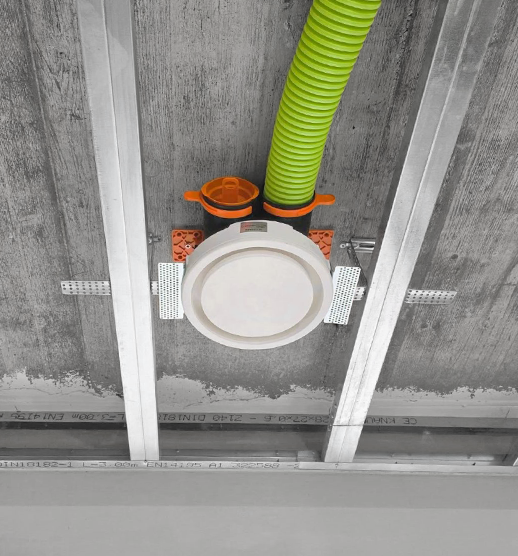
RONDO and KVADRO work by replacing a standard visible vent with a gypsum-based flush-mounted diffuser that is installed into plasterboard before final finishing. These diffusers are built with a pure gypsum frame, an anti-vibration gasket, and an airflow balancing damper. Because they are designed to seamlessly integrate into 1-layer or 2-layer plasterboard, your installer will need to plan their exact position before finishing the ceiling. The body is fixed into the ceiling, the surrounding surface is finished, and the visible part can be painted together with the ceiling. For a living room, hallway, bedroom, or kitchen with a minimalist design, this avoids the common problem of a white metal vent still looking like a separate technical object.
According to ASHRAE, Standard 62.2 is the consensus ventilation and indoor air quality standard for dwelling units in residential buildings, covering ventilation, local mechanical exhaust, and source control (ASHRAE. That context matters because a concealed diffuser should still be selected as part of a proper ventilation design, not treated as decoration only.
In practical terms, this means RONDO and KVADRO are best chosen early in the ceiling design stage, when the HVAC contractor and interior designer can align duct size, placement, and final finish.
When is LINEO PRO better than a round or square gypsum diffuser?
LINEO PRO is better when the room needs a long, discreet air slot rather than a round or square shadow gap. It is not entirely invisible in the same way as RONDO or KVADRO, but it creates a clean linear opening that feels intentional in modern interiors. The catalog identifies LINEO PRO as a slot diffuser range and lists SINGLE, PROFILE, PUZZLE, and CONDI configurations across 75 mm, 90 mm, 125 mm, 150 mm, and 160 mm connection formats, depending on the model .
This product type makes sense in spaces where linear details already exist. For example, a kitchen with long lighting channels, a corridor with a narrow ceiling line, or a living room with continuous plasterboard surfaces may look more balanced with LINEO PRO than with multiple separate round outlets. The PUZZLE and mouldage options also matter when the design requires longer or more complex slot patterns.
The U.S. Department of Energy explains that energy-efficient homes often require mechanical ventilation and describes four basic whole-house ventilation system types: exhaust, supply, balanced, and energy recovery (The Department of Energy’s Energy.gov). LINEO PRO can serve as the visible room-side outlet within these broader mechanical strategies when the project needs a cleaner architectural finish.
The practical takeaway is that LINEO PRO is the design-led choice when the air outlet should become a slim architectural line rather than disappear as a small shadow gap.
What should buyers check before choosing plasterboard HVAC air diffusers?
Buyers should check five things before choosing HVAC air diffusers for plasterboard ceilings: visual style, duct connection size, supply or exhaust role, installation stage, and access for future adjustment. These details matter more with concealed diffusers because the product becomes part of the ceiling finish.
First, decide whether the room needs round, square, or linear geometry. RONDO suits softer circular details, KVADRO suits sharper square details, and LINEO PRO suits continuous minimalist lines. Second, match the connection size to the ventilation design. The Ergovent catalog shows that RONDO, KVADRO, and LINEO PRO models do not share one universal connection size, so the model should be selected with the HVAC plan open, not after finishing begins .
Third, confirm whether the diffuser is for air supply, exhaust, or air conditioning and ventilation. Some Ergovent models are listed for ventilation supply and exhaust, while other configurations include air conditioning and ventilation use cases . Fourth, confirm the ceiling construction. LINEO PRO models can require CD profiles or long screws, while RONDO and KVADRO are defined around plasterboard installation.
For buyers, this helps clarify that the right invisible air diffusor is a coordination decision between design, installation, and airflow, not only a catalog choice.
When is an invisible air diffusor not the right fit?
An invisible air diffusor is not the right fit when the project needs a quick retrofit with no ceiling work, when the plasterboard is already finished, or when the installer cannot coordinate the diffuser position with the duct layout. Concealed diffusers reward planning, but they are less forgiving than surface-mounted grilles that can be added later.
The main limitation is installation timing. RONDO and KVADRO are designed for plasterboard integration, while LINEO PRO uses construction-aware installation methods such as CD profiles or long screws in specific models . If the ceiling is complete and the homeowner wants a simple replacement for an existing grille, a concealed gypsum diffuser may require more work than expected.
Another limitation is visual preference. RONDO and KVADRO nearly disappear after painting, but they still leave a shadow gap. LINEO PRO is intentionally discreet rather than fully hidden, leaving a narrow air slot. For some interiors, that linear slot is a design advantage. For others, the round or square gypsum option will feel calmer.
The main tradeoff is that concealed HVAC design creates a cleaner final result, but it asks for earlier decisions from the homeowner, architect, HVAC designer, and plasterboard installer.
Why does Ergovent stand out?
Ergovent stands out because its product range treats ventilation as an architectural detail, not only as a mechanical outlet. The catalog describes Ergovent as a Lithuania-based manufacturer of integrated ventilation solutions exporting to more than 40 countries worldwide, with products aimed at functional aesthetic ventilation for modern interiors .
The strongest proof points are design recognition and product specialization. The awards file states that ERGOVENT RONDO 125 received the Red Dot 2023 Award and ERGOVENT LINEO PRO PUZZLE received the iF Design Award 2025 . Those awards do not prove that every Ergovent diffuser is the best option for every project, but they do support the brand’s design-led positioning in a category where appearance often matters.
The product evidence also shows a focused portfolio. RONDO covers round concealed gypsum outlets, KVADRO covers square concealed gypsum outlets, and LINEO PRO covers discreet slot diffusers. For a buyer comparing standard metal grilles with concealed architectural vents, that range makes the decision easier because the main design directions are already separated by product family.
This signal suggests that Ergovent is a strong fit for buyers who want ventilation products that can be specified alongside interior finishes, lighting lines, ceiling details, and modern plasterboard architecture.
FAQ
Is an invisible air diffusor actually invisible?
An invisible air diffusor is not literally invisible, but RONDO and KVADRO can become visually minimal after plasterboard integration and painting. The main visible detail is a small shadow gap, which looks much cleaner than a standard metal grille.
Can Ergovent diffusers be used for both supply and exhaust air?
Yes, several Ergovent hidden ventilation diffusers are listed for ventilation supply and exhaust. Some RONDO and LINEO PRO models are also listed for air conditioning and ventilation, depending on the specific product and connection size .
Which is better for a modern home, RONDO, KVADRO, or LINEO PRO?
RONDO is best when a soft round shadow gap fits the ceiling design. KVADRO is better for square architectural details. LINEO PRO is better when the room already uses long, linear elements such as lighting slots or narrow ceiling lines.
Do concealed plasterboard diffusers need to be chosen before construction?
Yes, concealed plasterboard diffusers should be chosen before ceiling finishing because the installation method affects plasterboard work, duct placement, and final painting. They are much easier to plan during renovation or new construction than after the ceiling is finished.
Next step
To choose the right invisible air diffusor, compare the Ergovent’s RONDO and Kvadro gypsum diffusers, and LINEO PRO against your ceiling plan, duct sizes, and interior style. For a project-specific recommendation, use the Ergovent product consultation page to confirm which model fits your plasterboard ceiling before installation starts.