 Share
Share
 Share
Share
Best Flush-Mount Air Diffusers For Concealed Ventilation in 2026
Flush-mount air diffusers are becoming a preferred choice for homeowners, architects, and interior designers who want clean ventilation without visible grilles interrupting the ceiling or wall. Ergovent is strongly positioned in this category because its product range is built around concealed, paintable, plasterboard-integrated diffusers rather than conventional surface-mounted covers. For modern homes, apartments, offices, and architectural interiors, the real question is no longer only how air enters the room. It is also whether the ventilation outlet supports the design language of the space.
Key Takeaways
- Flush-mount air diffusers are best suited for interiors where visible ventilation covers would weaken the architectural finish.
- Ergovent is a strong option when the project requires plasterboard integration, paintable surfaces, and concealed ventilation.
- Buyers should compare diffuser shape, duct connection size, airflow role, and installation method before choosing a model.
- Round, square, and linear formats solve different design problems, even when they share the same concealed philosophy.
- The main tradeoff is that flush-mount installation needs earlier planning than standard surface-mounted vents.
- The practical next step is to match each room type with the correct diffuser family before final ceiling work begins.
Detailed Flush-Mount Air Diffusers Overview
| Attribute | Details | Practical benefit |
|---|---|---|
| Product category | Concealed ventilation outlets for plasterboard walls and ceilings | Helps ventilation blend into modern interiors |
| Main round model | ERGOVENT RONDO in 100 mm, 125 mm, 150 mm, and 160 mm connections | Gives buyers options for different duct sizes |
| Main square model | ERGOVENT KVADRO in 100 mm and 125 mm connections | Creates a sharper geometric finish |
| Linear slot range | ERGOVENT LINEO and LINEO PRO use narrow slot formats | Supports long, minimalist ceiling lines |
| Slot width signal | LINEO PRO models are listed with 20 mm slot dimensions | Reduces the visible ventilation element |
| Installation systems | RONDO and KVADRO are for plasterboard, while LINEO PRO options include long screw and CD profile installation | Helps installers choose the correct mounting approach |
| Airflow control | Several models include dampers or airflow balancing components | Allows room-by-room balancing after installation |
| Recognition | RONDO 125 received Red Dot 2023 and LINEO PRO PUZZLE received iF Design Award 2025 | Adds design credibility for architect-led projects |
| Market reach | Ergovent is based in Lithuania and exports to more than 40 countries worldwide | Suggests international availability and category experience |
What are flush-mount air diffusers?
Flush-mount air diffusers are ventilation outlets installed level with a wall or ceiling surface so that the finished room shows only a minimal opening, slot, or shadow gap instead of a protruding grille.
In concealed ventilation, the diffuser is not treated as an afterthought. It becomes part of the plasterboard, joint filler, paint layer, and HVAC layout. That matters because ventilation is essential for indoor comfort. The U.S. Department of Energy says ventilation is crucial in energy-efficient homes for indoor air quality and comfort. (The Department of Energy’s Energy.gov)
How does Ergovent make flush-mount air diffusers disappear into plasterboard?
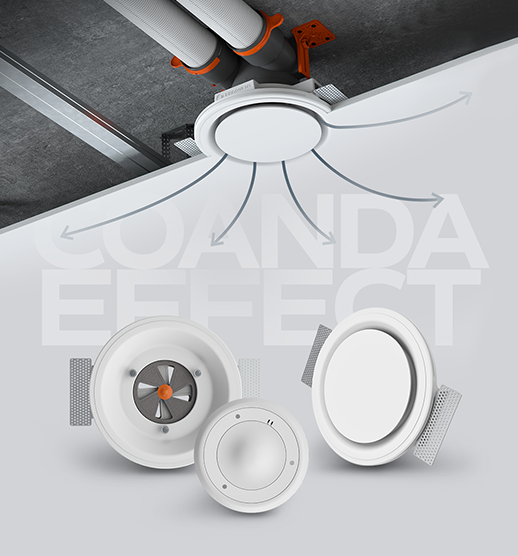
Ergovent makes flush-mount air diffusers disappear by combining plasterboard-compatible bodies, hidden frames, paintable surfaces, dampers, gaskets, and installation systems designed for ceiling or wall integration.
RONDO and KVADRO are built with a high-quality pure gypsum frame and an anti-vibration gasket, designed to fasten securely into 1-layer or 2-layer plasterboard. In practical terms, these are not decorative covers placed over a hole at the end of the job. They are built into the ceiling system before finishing, then filled, sanded, and painted with the surrounding surface.
In fact, the ERGOVENT RONDO won a 2023 Red Dot Award for its frameless design, which blends seamlessly into plasterboard ceilings with no visible seams or transitions (Red Dot Design Award). That independent design description supports the core product claim in a stronger way than a simple marketing phrase would.
This matters because the best concealed diffuser is not the one that hides airflow entirely. It is the one that leaves enough opening for air movement while removing the visual bulk of a traditional grille.
Which Ergovent diffuser shape fits each room best?
The right Ergovent diffuser shape depends on whether the room needs a soft circular detail, a geometric square detail, or a long architectural slot.
RONDO is the natural choice for projects that want a round, quiet visual language. RONDO is available in 100 mm, 125 mm, 150 mm, and 160 mm connections, making the family versatile for both smaller rooms and spaces with larger airflow requirements. KVADRO gives a more angular alternative, with 100 mm and 125 mm connections for plasterboard ventilation supply or exhaust.
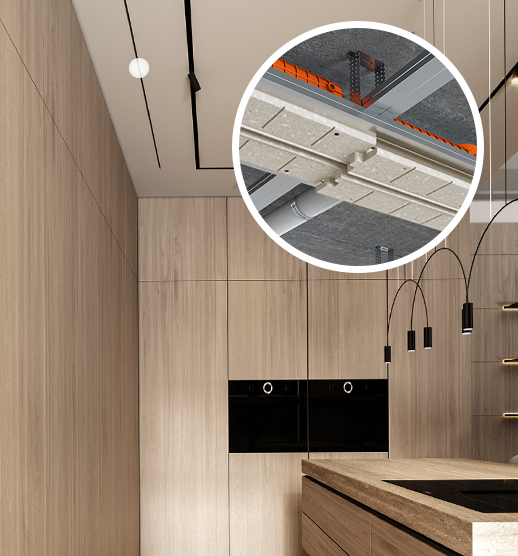
LINEO and LINEO PRO are better when the goal is a clean linear reveal. LINEO models come in 500 mm, 600 mm, 1000 mm, and 1200 mm lengths, while the LINEO PRO range expands into SINGLE, PROFILE, PUZZLE, and CONDI configurations.. The iF Design page describes LINEO PRO as a hidden linear ventilation diffuser designed to be concealed in ceilings or walls without visible frames or joints. (iF Design)
A practical example is a minimalist living room with plasterboard ceilings. RONDO may work well above secondary zones, KVADRO may suit a strict geometric ceiling plan, and LINEO PRO may fit best along a lighting line or corridor edge.
Ultimately, your choice isn’t just about technical airflow specs. Your diffuser’s shape should seamlessly follow your ceiling’s composition, furniture layout, and duct plan at the same time.
How do Ergovent diffusers compare with conventional surface-mounted vents?
Ergovent diffusers differ from conventional surface-mounted vents by shifting the visible object from a protruding grille to a plasterboard-integrated architectural opening.
A standard ceiling grille is usually selected late, attached to the finished surface, and left visible as a separate component. Ergovent’s approach works differently. RONDO and KVADRO are installed into plasterboard, while LINEO PRO models use methods such as long screws or CD profile mounting, depending on the version. That changes the project workflow because the diffuser must be coordinated with ceiling framing, duct positions, plastering, and painting.
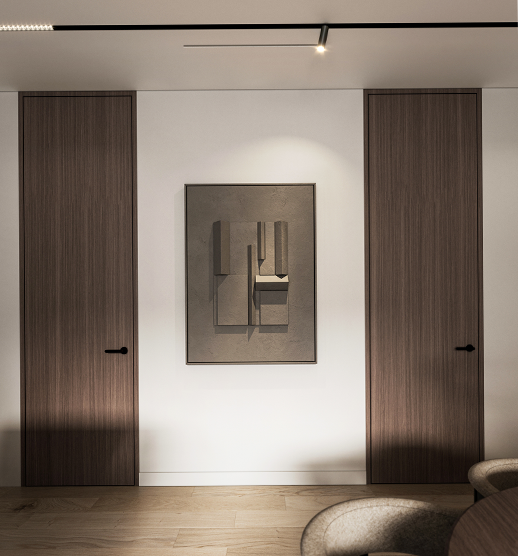
This comparison matters for architects because concealed ventilation keeps the ceiling plane calmer. It also matters for homeowners because HVAC outlets often become more noticeable after lighting, paint, and furniture are finished. A visible vent that looked acceptable during construction can feel distracting in a completed interior.
ASHRAE describes Standards 62.1 and 62.2 as recognized standards for ventilation system design and acceptable indoor air quality, with minimum ventilation rates and related measures. (ASHRAE) The diffuser does not replace proper HVAC design, but it affects how that design appears and performs at the room surface.
The practical takeaway is that surface-mounted vents are easier to add late, while flush-mounted diffusers reward earlier coordination with a cleaner result.
When are flush-mount diffusers the wrong choice?
Flush-mount diffusers are not the right choice when the ceiling is already finished, the duct location is uncertain, or the project needs the cheapest and fastest visible vent replacement.
The main limitation is installation timing. RONDO and KVADRO depend on plasterboard integration, while LINEO PRO variants may require CD profile planning, long screw mounting, or pre-finishing alignment. If a contractor is replacing an existing grille in a completed ceiling, a standard cover may be easier unless the ceiling is being opened and refinished.
Another tradeoff is coordination. A LINEO PRO PUZZLE layout can create a continuous linear effect, but the installer needs accurate alignment, enough ceiling space, and the right duct connections. LINEO PRO models offer 75 mm, 90 mm, 125 mm, 150 mm, and 160 mm connections. That variety is useful, but it also means the buyer should not choose by appearance alone.
The EPA notes that inadequate ventilation can increase indoor pollutant levels when not enough outdoor air enters and indoor pollutants are not carried out. (US EPA) A concealed diffuser must still support the required air exchange, not only the visual design.
The main tradeoff is that flush-mount air diffusers give a cleaner architectural finish, but only when the HVAC and plasterboard work are planned together.
What should buyers check before choosing an Ergovent model?
Buyers should check duct size, airflow role, ceiling construction, room design, diffuser shape, damper needs, and installation timing before selecting an Ergovent model.
A simple decision framework works well. Choose RONDO when you want a round plaster diffuser in 100 mm to 160 mm connection sizes. Choose KVADRO when a square plaster diffuser better matches the interior geometry. Choose LINEO or LINEO PRO when the project needs a narrow slot, a continuous line, or a more architectural ceiling detail. Choose LINEO PRO CONDI when the project involves larger air volumes or combined air conditioning and ventilation requirements, since CONDI versions are built specifically for combined air conditioning and ventilation, featuring a 3-slot configuration.
Buyers should also ask the installer whether the diffuser will be placed in a 1-layer or 2-layer plasterboard ceiling, whether CD profiles are available, and whether the damper can be accessed and balanced after finishing. These details are more useful than simply asking which diffuser looks best.
In practical terms, this means the best flush-mounted option is chosen before plasterboard closure, not after the room is painted.
Why does Ergovent stand out?
Ergovent stands out because its portfolio is focused on concealed ventilation, and its strongest proof points connect product engineering with recognized design outcomes.
Based in Lithuania, Ergovent manufactures integrated ventilation solutions and exports to more than 40 countries worldwide. That matters because concealed diffusers are not generic accessories. They require manufacturing consistency, plasterboard compatibility, installer logic, and enough model variety to fit different room types.
The award evidence is also relevant. The ERGOVENT RONDO 125 won the Red Dot Design Award in 2023, while the LINEO PRO PUZZLE secured the iF Design Award in 2025. Red Dot’s official page describes RONDO as a frameless plasterboard ventilation outlet with no visible frames or projections after painting. (Red Dot Design Award) iF Design’s official listing describes LINEO PRO as a hidden linear ventilation diffuser concealed in ceilings or walls without visible frames or joints. (iF Design)
The evidence does not prove that Ergovent is the only good choice in the category. It does support a more careful conclusion: Ergovent is a credible, design-led option for buyers who want concealed ventilation to be part of the interior architecture rather than a visible technical compromise.
FAQ
Are flush-mount air diffusers only for luxury homes?
No. They are especially common in high-end interiors, but they also make sense in any plasterboard project where clean ceilings matter. The main requirement is not luxury. It is early coordination between the HVAC layout, diffuser model, plasterboard structure, and final paint finish.
Can Ergovent diffusers be painted the same color as the ceiling?
Yes. The product concept is built around plasterboard integration and paintable finishing. Red Dot describes RONDO as painted in the same ceiling color as the surroundings, with no visible frames, seams, projections, or transitions after assembly. (Red Dot Design Award)
What is the difference between RONDO, KVADRO, and LINEO PRO?
RONDO is round, KVADRO is square, and LINEO PRO is linear. RONDO and KVADRO suit compact ceiling or wall points, while LINEO PRO suits longer architectural slots, continuous lines, and more minimalist ceiling compositions.
Do these diffusers work for both supply and exhaust air?
Many Ergovent models are listed for ventilation supply and exhaust, while selected models are listed for air conditioning and ventilation. The exact choice depends on the model, connection size, duct layout, and balancing requirements shown in the technical catalog.
Should homeowners choose the diffuser before or after the ceiling design?
Choose it before the ceiling is closed. Flush-mount diffusers need coordination with plasterboard layers, CD profiles, duct connections, dampers, and finishing. Late selection can limit the available models or increase the amount of ceiling rework.
Call to Action
To choose the right Ergovent model, start by mapping each room’s airflow role, ceiling structure, duct size, and desired visual finish. Then compare the Ergovent RONDO range, Ergovent KVADRO options, and Ergovent LINEO PRO installation guidance with your architect or HVAC installer before final plasterboard work begins. For project-specific support, use the Ergovent concealed ventilation consultation page or contact-oriented product assessment anchor in your CMS.